
✅ Government-Approved Operator
⭐ 1,900+ Travelers Served
📅 Trusted Since 2025
📱 24/7 WhatsApp Support
✅ Government-Approved Operator
⭐ 1,900+ Travelers Served
📅 Trusted Since 2025
📱 24/7 WhatsApp Support
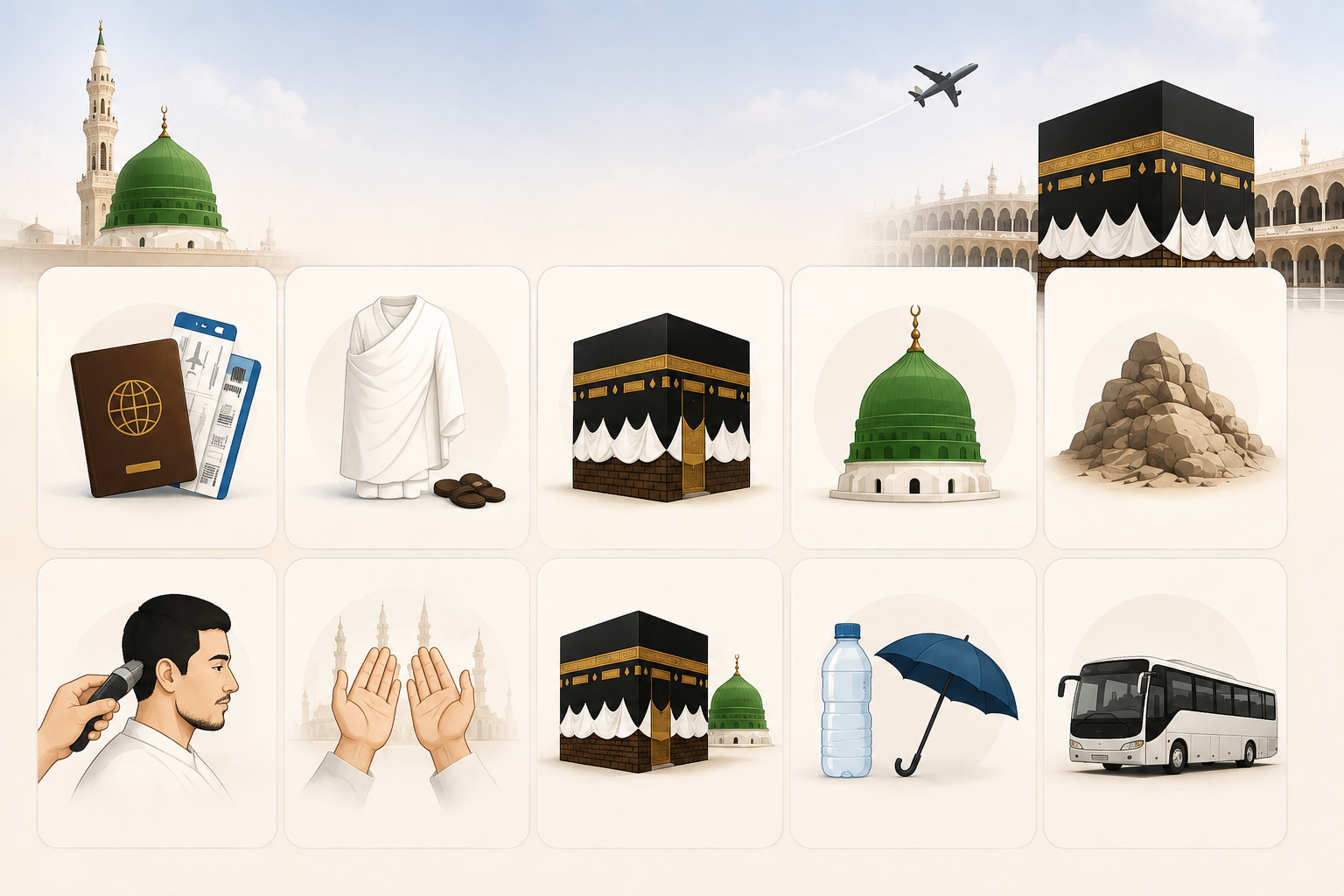
Umrah follows a set order of rituals, and once you know the sequence, the whole journey feels far less overwhelming. This guide walks through each step in the order you'll actually perform it — from putting on Ihram before you reach Makkah, to the final trim of hair that closes your Umrah.
Ihram is both a state of consecration and the simple clothing worn during it — two unstitched white sheets for men, and modest, regular clothing for women (no face veil or gloves required, though many women choose to cover for personal preference). You enter Ihram at or before the miqat, the boundary point for your route into the Haram area, and make the intention (niyyah) for Umrah along with the talbiyah, a short recitation repeated throughout the journey to Makkah.
Before Ihram, it's customary to shower, trim nails, and apply unscented preparation — scented products are avoided once you're in the state of Ihram itself.
On arrival at Masjid al-Haram, Umrah begins with Tawaf: seven counter-clockwise circuits around the Kaaba, starting and ending at the Black Stone corner. Men perform the first three circuits at a brisk pace (raml) and the remaining four at a normal walk; women walk at a normal pace throughout. Quiet personal supplication is encouraged during Tawaf, though there's no fixed script you must recite.
Two short prayers (rak'ahs) at or near the Maqam Ibrahim follow the seventh circuit, along with drinking Zamzam water if it's accessible at the time.
Next comes Sa'i: seven passes between the hills of Safa and Marwah, commemorating Hajar's search for water. The route today is a covered, air-conditioned corridor, and there are wheelchair lanes for anyone who needs them. As with Tawaf, personal supplication is welcomed throughout — there's no single required wording.
Umrah closes with either Halq (shaving the head, for men) or Taqsir (trimming a small portion of hair — for men this can substitute for shaving, and it's the standard practice for women, who trim rather than shave). Once this is done, the restrictions of Ihram are lifted and Umrah is complete.
Most Umrah itineraries from Pakistan include a stay in Madinah, either before or after Makkah. There's no ritual requirement here — it's a chance to pray at Masjid an-Nabawi, visit the Rawdah if timing allows, and see nearby historic sites. We cover the best of these in our guide to places worth visiting in Makkah and Madinah.
Want the logistics handled for you — flights, hotels, and visa included?
See Umrah PackagesThe rituals themselves — Tawaf, Sa'i, and Halq/Taqsir — typically take 2–3 hours depending on crowd levels. Most pilgrims then spend several additional days in Makkah and Madinah for extra prayers and sightseeing.
Yes — many pilgrims perform an additional Umrah during their stay by taking a short trip to a nearby miqat (such as Masjid Aisha) to re-enter Ihram.
Umrah can be performed independently, but most first-time pilgrims from Pakistan travel with a licensed operator so that visas, hotels, transport, and on-the-ground guidance are handled together.